
Key Takeaways
- Surface-dry and structurally dry are two different conditions: carpet and drywall can test dry to the touch while framing and insulation underneath still hold enough moisture to grow mold.
- Water moves upward into drywall and wall cavities through capillary action for hours or days after the visible flood is gone, which is why a wall that felt fine on day one can test wet on day four.
- A single moisture reading tells you almost nothing without a dry-standard baseline for comparison and a few days of tracked readings to confirm the material has actually stabilized.
- Open-air drying with a fan lowers surface moisture but does not control room humidity, so water pulled out of wet carpet can simply redeposit into a nearby wall or baseboard.
- Structural drying isn’t the right call for every leak: a small, quickly caught spill on a hard floor with no wall or subfloor contact often just needs surface drying and a moisture check.
A floor can feel bone-dry to the touch on day two and still be feeding mold underneath on day five. Structural drying returns a material’s actual moisture content, not just its surface feel, to a safe baseline using controlled airflow and dehumidification. Moisture meters exist because human hands are a terrible sensor, and the gap between what a surface feels like and what a material actually contains is where most water damage jobs go wrong.
Dry to the touch and structurally dry are different finish lines
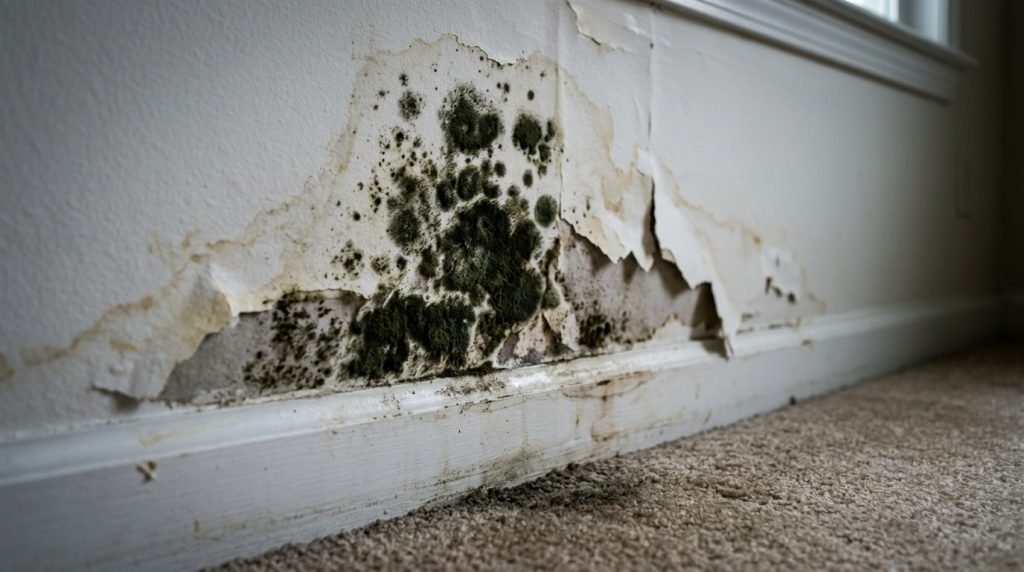
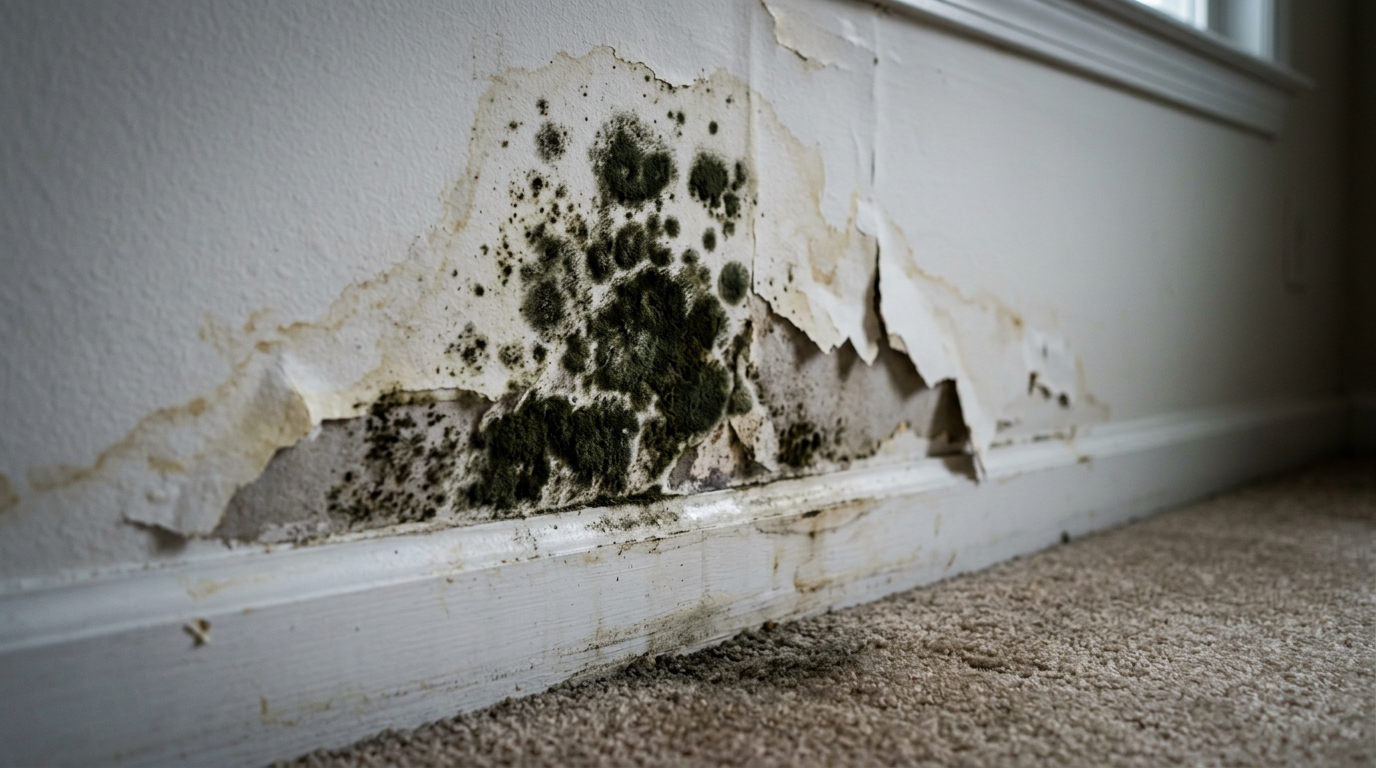
Dry to the touch means the surface has lost enough moisture that your hand can’t detect it. Structurally dry means the material itself, measured by percentage moisture content against a dry-standard baseline, has returned to a range where it can’t support mold growth or further deterioration. These are not the same finish line, and treating them as one is the most common mistake in a DIY dry-out. The reason is capillary action. Water doesn’t stay where it lands, it wicks upward into drywall and insulation through the tiny pore structure of the material itself, climbing well above the visible waterline long after the surface has evaporated. A wall can test bone-dry at the baseboard and still hold saturation two inches higher inside the cavity, invisible from either side. The most common mistake is trusting touch alone: a wall can feel dry on the surface while moisture stays trapped deep in the studs, insulation, or wall cavity. That’s why a visual check and a hand test prove nothing on their own.
Surface drying and structural drying restore different materials on different timelines
Surface drying deals with what you can see: carpet, carpet pad, and exposed flooring. Structural drying deals with what you can’t see: subfloor, wall cavities, framing, and insulation, using controlled airflow and dehumidification measured in days rather than hours. Neither one substitutes for the other.
| Surface drying | Structural drying | |
|---|---|---|
| Targets | Carpet, pad, exposed flooring | Subfloor, framing, wall cavities, insulation |
| Method | Fans, open air, surface extraction | Controlled airflow + dehumidification |
| Timeline | Hours | Multiple days, verified by readings |
| What it leaves behind | Wet framing, damp insulation if untouched | Little to nothing, if run to completion |
Surface drying is faster and cheaper, and for water that never reached a wall or subfloor, it’s often all that’s needed. Structural drying takes longer and costs more because it solves a slower, hidden problem. Choose surface drying when the water stayed on top of a hard surface and never touched a wall base or seam. Choose structural drying when carpet, baseboards, or drywall were saturated, because moisture has almost certainly migrated past what you can see.
How a burst pipe soaks walls and carpet in the first 24 to 72 hours
Within the first few hours, water from a burst pipe spreads laterally under baseboards and along the subfloor, following the path of least resistance rather than pooling neatly where the pipe failed. Carpet pad absorbs like a sponge almost immediately, holding water long after the top of the carpet looks dry. By hour 12 to 24, that moisture has started climbing into the drywall through capillary action, working past the baseboard and into the wall cavity itself. By 48 to 72 hours, conditions inside a wet wall cavity, dark, warm, and humid, are already in the range where mold can begin colonizing. The lesson isn’t “hurry up.” It’s that the clock inside a wall runs faster than the clock on the surface you can see, and a response measured in days rather than hours is working against biology.
A fan and an open window don’t replace structural drying
A fan pointed at wet carpet does dry the surface faster, and that’s exactly why people assume it’s solved the problem. Open-air drying lowers surface moisture but does nothing to control humidity in the room, so the water that just evaporated off the carpet is now floating as vapor with nowhere productive to go. That vapor doesn’t disappear. It redeposits into whatever nearby material is coolest or most absorbent, often a baseboard, a closet wall, or furniture legs, which is why unmonitored fan-drying sometimes just relocates the water instead of removing it. On a mold job at a local extended-stay hotel, fan-only drying pushed moisture into the void behind a baseboard that went unnoticed until secondary mold surfaced weeks later. Structural drying works because it pairs airflow with dehumidification, actually pulling moisture out of the air and the building rather than just moving it around the room. If you’re relying on a fan and an open window for anything beyond a small, contained spill, you’re managing appearance, not moisture.
A single moisture reading needs a dry-standard baseline to mean anything
A moisture meter reading on drywall or wood framing is only meaningful when compared against a dry-standard baseline, a reading taken from unaffected material in the same structure. Without that baseline, a number like 18% means nothing on its own, because dry-standard moisture content varies by material and region. Statewide Restoration relies on a non-penetrating meter to quickly scan unaffected surfaces for that baseline, then uses a penetrating meter to take direct readings in the affected material. What to actually check:
- Baseline first. Confirm a dry-standard reading was taken from unaffected material before any drying number is treated as meaningful.
- Material matters. Drywall, wood framing, and subfloor each have different acceptable moisture ranges; the same percentage can mean fine on one and saturated on the other.
- One reading proves nothing. A single check tells you the moisture level at that moment, not whether the material is still releasing water or holding steady.
- Track daily until stable. Readings need to be logged across consecutive days until they plateau near the dry standard; a stopped trend, not a single low number, confirms the material is done drying.
Frequently asked questions
How long does structural drying take compared to just drying the carpet?
Surface drying of carpet and pad can look complete within hours using fans or extraction. Structural drying of subfloor, framing, and wall cavities takes several days of continuous airflow and dehumidification, with completion confirmed by moisture readings stabilizing near a dry-standard baseline rather than by a fixed number of hours.
Can a floor look fine but still have mold risk underneath it?
Yes. Flooring and subfloor can retain moisture well after the visible surface looks and feels normal, because water travels into subfloor material and stays trapped beneath flooring that blocks airflow. A visual check tells you nothing about what’s happening one layer down; only a moisture reading against baseline confirms it.
What happens if drying stops before moisture readings return to normal?
Any material still above dry-standard moisture content remains a candidate for mold growth and continued material breakdown, even if it looks and feels dry on the surface. Stopping early doesn’t fail immediately, it fails quietly, days or weeks later, which is why tracked readings matter more than a visual sign-off.
When is structural drying not necessary for a small, quickly caught leak?
A small spill caught within minutes on a hard, non-porous surface that never reached carpet, baseboards, or a wall seam usually only needs surface wiping and a follow-up moisture check. Structural drying becomes necessary once water has contacted a porous material or sat long enough to migrate past the surface.
Does insurance cover structural drying separately from carpet replacement?
Structural drying and carpet or flooring replacement are generally treated as separate line items on a water damage claim, since they address different types of damage. Coverage details vary by policy, so the specific breakdown is something to confirm directly with the insurance carrier or adjuster handling the claim.
Assessing what’s actually happening in your walls
Before assuming a leak is handled, check whether the water ever reached a wall base, baseboard, or subfloor, not just whether the carpet or floor looks dry today. If it did, a moisture reading against a real baseline, tracked over a few days, is the only way to know whether the material underneath has actually stopped holding water. If you’re dealing with a leak that reached walls, carpet, or subfloor and you want that moisture question answered with actual readings instead of a guess, Statewide Restoration Inc’s rapid response team handles structural drying with IICRC-certified technicians across the Charlotte area.