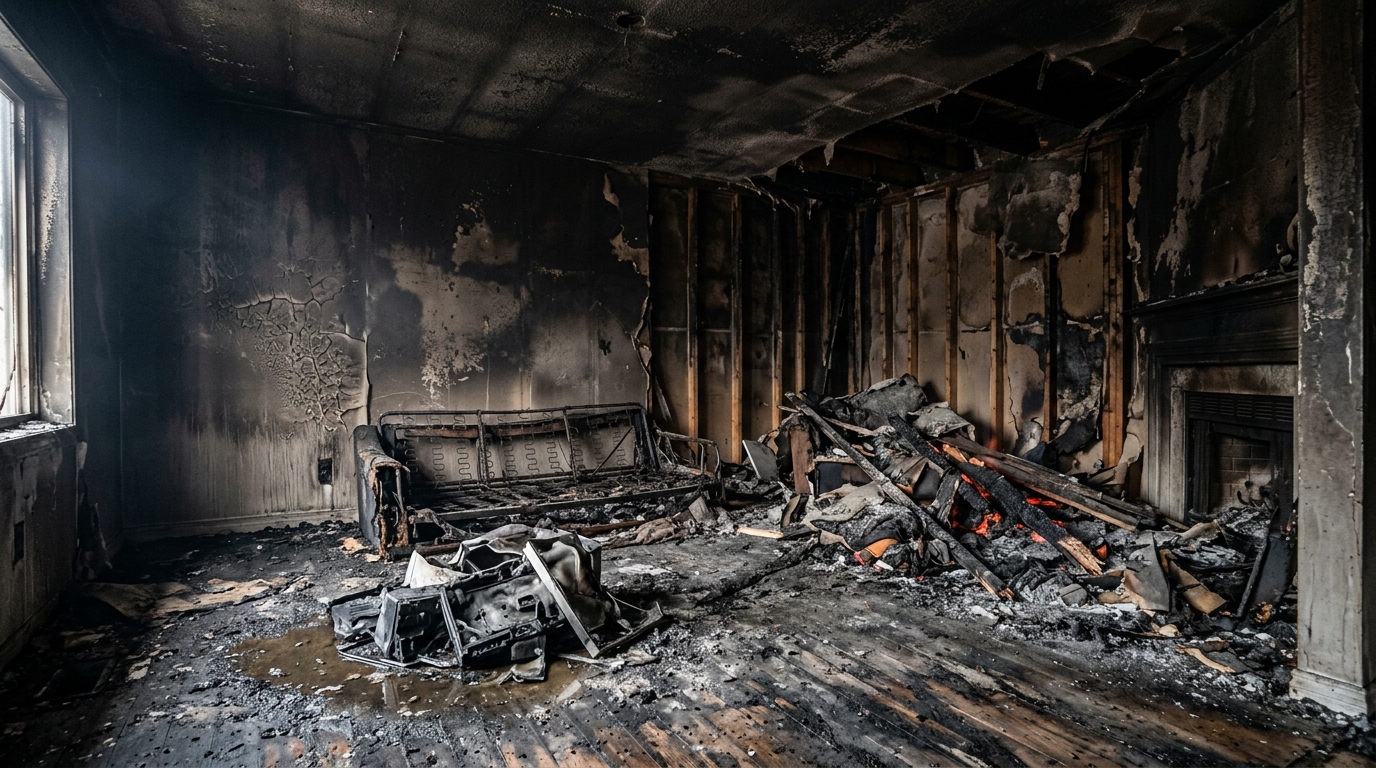

Right after a fire, the timeline that matters isn’t days. It’s hours. Acidic soot starts pitting metal within about 72 hours of exposure, and the longer smoke residues sit, the harder they bond to porous materials like drywall, wood, and insulation (IICRC S700, 2025). What you do in the first day changes how much of your house gets saved.
I run Statewide Restoration in Charlotte. We’re IICRC-certified and work under the ANSI/IICRC S700 standard on every fire job. This page walks through what to do before we arrive, what we do when we get there, and what to actually expect on timeline and cost. If you’re in the middle of it right now, call (704) 559-9922. Otherwise, keep reading.
What to do in the first hour
Once the fire department clears the property, you have a short window before secondary damage compounds. A few decisions here make a real difference to what gets saved.
Call your insurance carrier and open the claim before you do anything else. Most homeowner policies expect you to start mitigation within 24 to 72 hours, and delays can turn into a coverage issue.
Photograph everything, including rooms that look untouched. Smoke travels through HVAC ducts, pressure differentials, and porous materials, so damage often shows up far from the fire (NFRA, 2025). If those rooms turn out to be affected, your baseline photos are what proves it to the adjuster.
Do not run the HVAC. Every minute the system runs, it pushes soot into rooms that were otherwise clean, and into ductwork that’s expensive to clean if it gets contaminated. Kill it at the breaker if you have to.
Do not wipe soot off walls with a dry cloth. It sounds counterintuitive, but wiping pushes particles deeper into paint and drywall, and it can turn a cleanable wall into one that needs replacement.
Do not turn on electrical appliances that were in the fire zone until a licensed electrician has inspected them. Fire and water both compromise electrical safety in ways that aren’t visible.
If the weather allows and the fire department has cleared it, open windows to ventilate. Fresh airflow slows the acidic reaction of smoke residues on surfaces.
What your belongings actually go through
More stuff survives than most people expect. When we walk into a house for the first time, we sort belongings by material and by how much smoke exposure each item took. That decision drives everything else.
Non-porous items like glass, metal, ceramics, and hard plastic clean up almost every time. Porous materials like fabric, wood, upholstery, and paper are more complicated. Whether we can save them depends on smoke type and how long the residue sat before we started cleaning.
Smoke type matters more than most homeowners realize. IICRC S700 recognizes four residue categories, and each needs different cleaning chemistry:
- Dry smoke comes from fast-burning, high-heat fires (paper, wood) and leaves powdery residue. Dry-cleaning methods and HEPA vacuums come first.
- Wet smoke comes from slow, smoldering fires burning synthetics like plastics and rubber. It’s sticky, sharp-smelling, and needs alkaline degreasers.
- Protein residue comes from kitchen fires. It’s the trickiest one. Nearly invisible, chemically bonded to surfaces, and requires specific emulsifiers plus mechanical agitation.
- Fuel-oil soot comes from oil-burning HVAC puffbacks and needs solvent cleaning followed by encapsulation.
Applying the wrong chemistry can permanently set the residue into your walls, ceilings, and floors. If a company shows up and starts cleaning without classifying the residue type first, that’s a bad sign.
The tools we use depend on what we’re cleaning: dry ice blasting for structural surfaces, ultrasonic cleaning for salvageable contents like electronics and jewelry, chemical sponges for dry soot, solvent extraction for oily residues. Documents, photos, and irreplaceable items go to a specialty vendor for freeze-drying and ozone treatment.
Do not throw anything away before we’ve looked at it. I’ve watched homeowners toss photo albums, wedding dresses, and heirloom furniture that would have been fine after professional treatment. If you’re not sure, set it aside.
Actually getting rid of smoke odor
Odor is the part homeowners are most skeptical about. Air fresheners and surface cleaning don’t work. The smell comes back within a week or two because you haven’t removed the source, you’ve covered it.
Smoke odor lives in porous materials. Volatile organic compounds absorb into the cellular structure of drywall gypsum, wood framing, textiles, and insulation, and they release back into the air over time. To actually eliminate the smell, you have to neutralize the VOCs at the source.
We use three methods depending on the scope:
Thermal fogging heats a deodorizing solvent into a vapor that penetrates porous materials the same way smoke did. It matches the smoke’s own diffusion pattern, which is why it reaches the same fibers.
Ozone treatment floods the structure with ozone gas, which oxidizes VOC molecules and breaks them down. It works, but nobody can be in the house during treatment (pets included). Typical run time is 24 to 72 hours depending on severity.
Hydroxyl generators use UV light to produce hydroxyl radicals that oxidize particles at a lower concentration than ozone. They’re slower but safe to run while people are living in the home. We use these on jobs where evacuation isn’t practical.
Before hiring any restoration company, ask specifically whether IICRC Fire and Smoke Restoration Technician (FSRT) certified technicians will be on-site doing the work. Not just the company being IICRC-certified. The actual people in your house. That question separates competent crews from bad ones.
How long this actually takes
Timelines vary more than most restoration companies admit. Here’s what we see in real Charlotte-area jobs.
A small kitchen fire contained to one room, with light smoke damage to adjacent areas, is usually one to two weeks. That covers cleaning, deodorization, and any touch-up painting.
A moderate fire involving structural damage, water damage from firefighting, and pack-out of contents typically runs four to eight weeks. The pack-out itself adds a week on the front end because we have to inventory everything for insurance and transport it to our facility for cleaning. Water damage runs in parallel under IICRC S500, since fire suppression water needs to come out fast to prevent mold.
A large fire with major structural loss can take three to six months, sometimes longer. Reconstruction is usually the bottleneck. Permits, inspections, and material lead times all pile up. The mitigation and cleaning phase might be done in a month, but the rebuild takes the rest.
The insurance process is the variable that surprises people most. A cooperative adjuster who responds quickly can shave weeks off a project. An unresponsive one can add them. We document everything to IICRC S700 standards (residue classification, moisture readings, chemistry logs, photo documentation) because that’s what adjusters need to approve the scope without back-and-forth.
Costs and what insurance typically covers
Fire damage restoration in the Charlotte area usually runs $3,000 to $50,000 or more, depending on scale. A small kitchen fire lands on the lower end. Full structural fires with pack-out and reconstruction land at the higher end.
Homeowner’s insurance covers most sudden-fire losses under standard HO-3 policies. What’s not covered varies: some intentional acts, some long-term smoke exposure from ongoing sources (not a single fire event), and damage that occurred because you delayed mitigation past what your carrier considers reasonable. That last one is why the “call the insurance carrier first” step matters. Starting the claim quickly protects you.
Your deductible applies, usually $1,000 to $2,500 for standard policies. If you have replacement cost coverage rather than actual cash value, you’ll get the full cost to repair or replace, minus depreciation on some items.
What Statewide Restoration handles
We’re available 24/7 across the Charlotte area. If the fire is at 3 AM, the response starts at 3 AM.
Every job runs to ANSI/IICRC S700 standards. Our lead technicians hold IICRC FSRT certifications. We handle the full scope: structural cleaning, contents pack-out, deodorization, water damage from suppression, and coordination with your insurance adjuster on documentation.
If you’re in the middle of it right now, call (704) 559-9922 or email info@swresto.com. If you’re planning ahead or want to know what a legit restoration company should look like before you need one, this page covers it.
Frequently Asked Questions
How soon after a house fire should I call a restoration company?
The moment the fire department clears the property. Acidic soot starts corroding metal within about 72 hours, and porous materials absorb VOCs from the first hour onward (IICRC S700, 2025). Most insurance policies also require mitigation to begin within 24 to 72 hours to preserve coverage. Fast response usually reduces total restoration cost too, since it prevents secondary damage from setting in.
What items can be saved after fire and smoke damage?
Non-porous items (glass, metal, hard plastics, ceramics) clean up in almost all cases. Porous items depend on smoke type and exposure duration. Documents, photos, textiles, and upholstery often can be saved through specialty treatments like freeze-drying, ozone chambers, and ultrasonic cleaning. Never throw anything away before a certified restorer assesses it. I’ve watched people discard things that would have been fine.
Can I stay in my home during restoration?
It depends on the treatment. Ozone treatment requires everyone out of the house, including pets, since ozone is a respiratory irritant at treatment concentrations. Hydroxyl generators can run while you’re home, which is why we use them when evacuation isn’t practical. For jobs with significant structural damage or major HVAC contamination, you’ll likely need temporary housing anyway, which most homeowner policies cover under Loss of Use.
Why does IICRC certification matter?
The ANSI/IICRC S700 standard, published in 2025, is the first consensus standard for fire and smoke damage restoration in the United States (Cleaning and Restoration, 2025). It defines how residues get classified, what chemistry cleans what, and what documentation your insurance carrier expects. Insurance adjusters treat S700 as the professional standard of care. If a contractor doesn’t hold IICRC FSRT certification or work to the S700 standard, they’re improvising with your house.
How common are house fires in the U.S.?
The National Fire Protection Association reported approximately 329,500 home structure fires in 2024, causing $11.4 billion in property damage. That’s roughly one home fire every 96 seconds (NFPA, 2025).
Sources referenced: ANSI/IICRC S700:2025 Standard for Professional Fire and Smoke Damage Restoration; NFPA “Fire Loss in the United States During 2024,” reproduced via Insurance Information Institute; National Fire Restoration Authority technical documentation on smoke damage restoration methods.